Office socialization
An instrumented office, 2012: a proof of concept
These slides run from what the study asked
to what kind of picture its approach gives.
- The place, the activity and the question
- What survives
- The instrument
- The method, running on one device
- Eight weeks and one day, traced
- The sound
- The model of activity, and its limits
- Sources
The study's anchor is a place,
and a container of candy is how it looked.
“So the place is the office, the activity is socialization, I think.”
For eight weeks in 2012, 24 open containers of candy stood across a Chicago company's offices, from busy walkways to small kitchenettes. Each stood on an instrument that stayed put while the office moved around it.
The question was whether cheap instruments
could reach an activity through its trace.
The trace
Taking candy: when, and in what way. A hand in a container changes its weight.
The activity
Socialization: who stops, when, alone or together. “What we really wanted to know was how conversation and taking events relate.”
A proof of concept: any number here describes these few devices and no others.
Most of the readings are gone,
and fragments survive inside the team's tools.
27 hours
One device's weight, kept in the team's tool as its demo. About 1 part in 1,100 of the study's.
31 hours
Another device's sound moments as classes, on two spells in September and October.
12 minutes
A sound training set from the day after the study ended. Where it was recorded isn't known.
The team's plots of the rest survive, and anything traced from them here is gray.
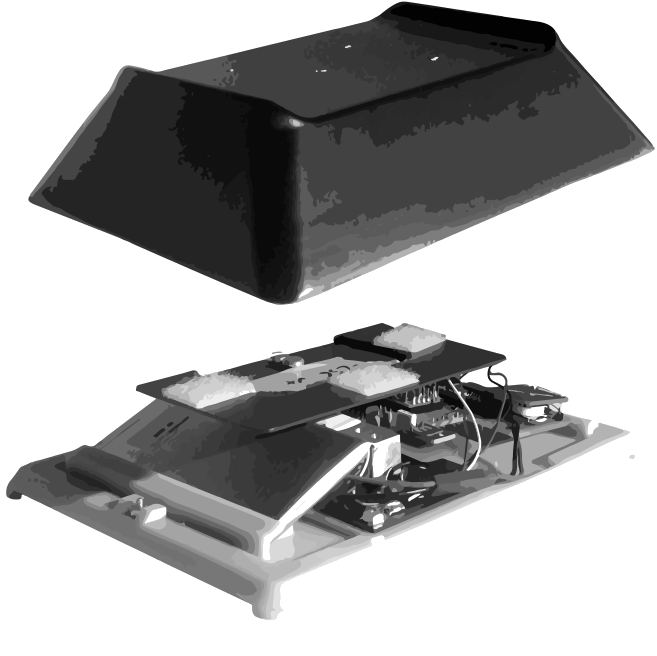
Each container stood on a kitchen scale,
pulled apart and refitted.
A load cell, a temperature and air pressure sensor, and a microphone behind a seven-band chip, which kept levels and never sound.
Eight ticks a second. It wrote a row when something changed, while the microphone was on, or every ten seconds.
The microphone heard about 2¼ hours
of a workday, in short windows.
So most taking has no sound beside it, and a voice is only ever a level across seven bands. Nothing it kept could be heard as speech.
The team looked for events two ways:
by knowing what to look for, and by not knowing.
Supervised: Sherlock
Training sets of a single piece, a handful, digging and a refill became fingerprints of duration, weight change and energy. A tool compared every moment with each one.
Unsupervised: shingles
Overlapping blocks of time with no idea of what was in them, then clusters of what the blocks held, and dynamic time warping to compare their shapes.
A fingerprint is three numbers,
and how much each of them matters.
Seven takings in two minutes could be
one person or five: the weight can't say.
The model counts a trace,
and the question stays open behind it.
“An observation is not an activity model.”
Such a record, TJ writes, “could be evidence relevant to a social hypothesis without itself being a measure of sociability. The model's value depended on whether the relationship … could be examined critically, not on whether a dispenser could count events accurately.”
What it could not tell was who,
how much, and whether anyone was together.
- Who, and with whom. The weight has no person in it, and the microphone no words.
- How much. “drift of the scale measurement (not being able to tare)”.
- Whether it was right. “acquiring data to validate events, capturing video (privacy concerns), and incomplete reporting on device locations.”
- Whether clusters mean anything. “Although it looks convincing, we don't know if it worked.”
As a proof of concept the approach held,
and gave a picture of rhythms and places.
- A kitchen scale could see a hand go into a container, and a tool could sort what it saw into kinds that can be examined case by case.
- The office's rhythms came through: the work week, the start of the day, lunch, and the end of the day.
- Places differed: some loud and some nearly silent, with taking in all of them.
- Sound and taking were set side by side, in short windows, and read by eye.
Everything on these slides traces
to a small set of sources.
- Device 1315's weight: two exports in Sherlock's demo, December 2012.
- Device 1414's sound moments and the training set: the team's sound tools, November 2012.
- Sherlock, its source and a recording of it running; the fingerprints in its settings.
- The instrument's firmware, September 2012.
- The team's plots of three devices, October 2012, and its charts, 2013, traced.
- TJ, Modeling Activity, 2026, pp. 3 and 4. TJ's earlier site, on the scope of the work.