Office beacons
iBeacons on two floors of the office, 2014: a proof of concept
The slides run from the question
to what the model could tell.
- The question and the anchor
- Two configurations, and the instruments
- How a position is made
- A walk, a day, who was near whom, and dwell
- Two floors, and the second phase
- How good a position is
- Who was tracked, and what survives
- What the model could and could not tell
The study asked whether radios on the walls
could say where people go in an office.
In 2014 the Iota team put about 150 iBeacons on two floors of the office, and a few people wore an iPod on the arm through the working day.
The anchor is a place, with people moving through it. The model of activity is where a device went and how long it stayed.
It was a proof of concept. Any number on these slides describes these few people, on these few days.
A record of where someone is
does not say what they are doing.
“An observation is not an activity model. A sensor may report that a door opened, a cup moved, or someone entered a room, but none of those events alone establishes what the person was doing.”
So the question here stays close to the instrument: was the approach viable, and what kind of picture does it give?
The team tried the idea two ways round,
one after the other.
Beacons on the walls, iPods on arms
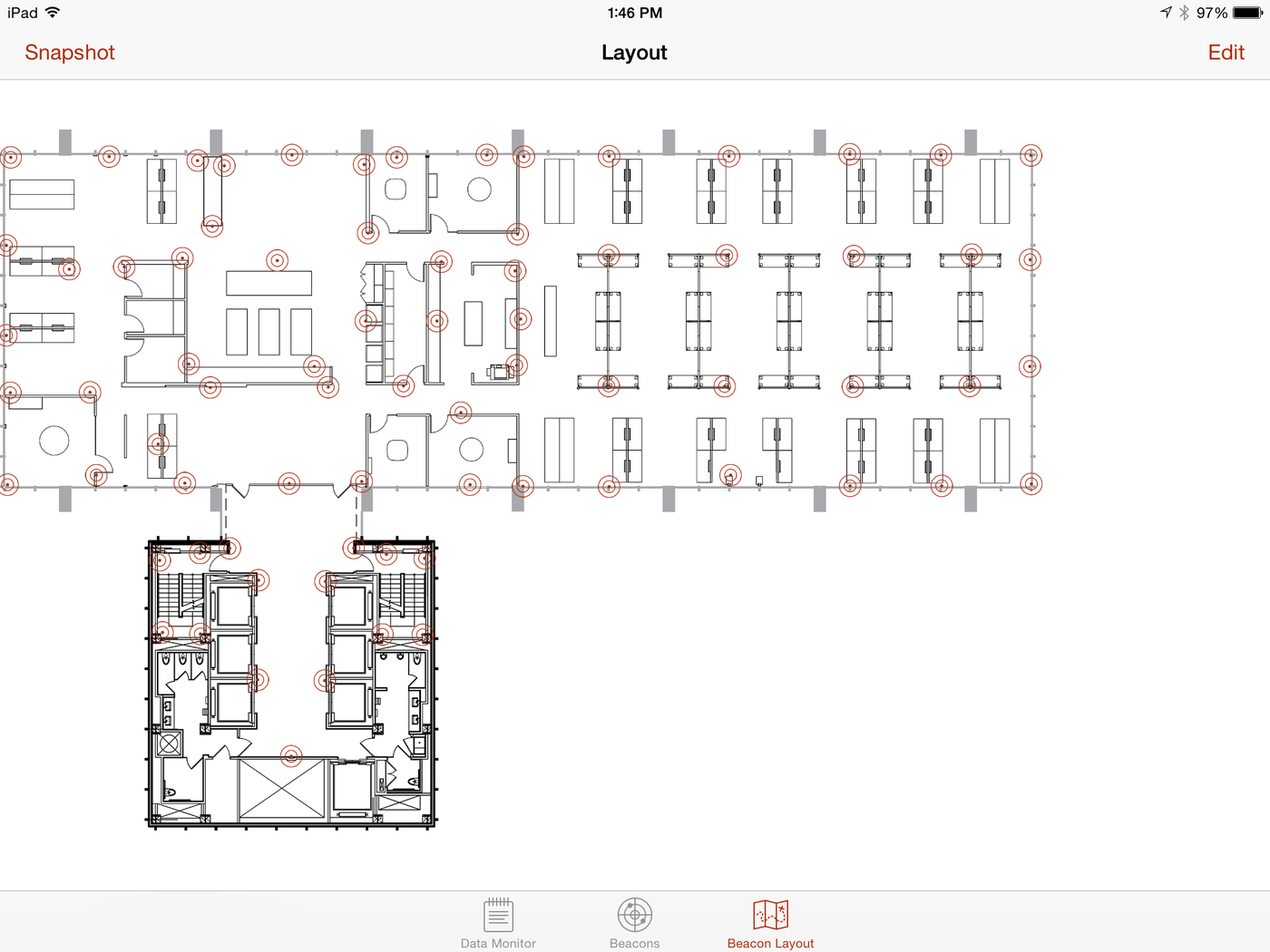
June to September. About 150 beacons on two floors, about 11 ft from the next. Seven iPods at a time, collected in the morning and returned at night.
iPods on the walls, beacons carried
October to early November. Seven iPods fixed on the walls at one end of the lower floor, and thirteen people each carrying a beacon.
The instruments were bought beacons and iPods,
with an app the team wrote.
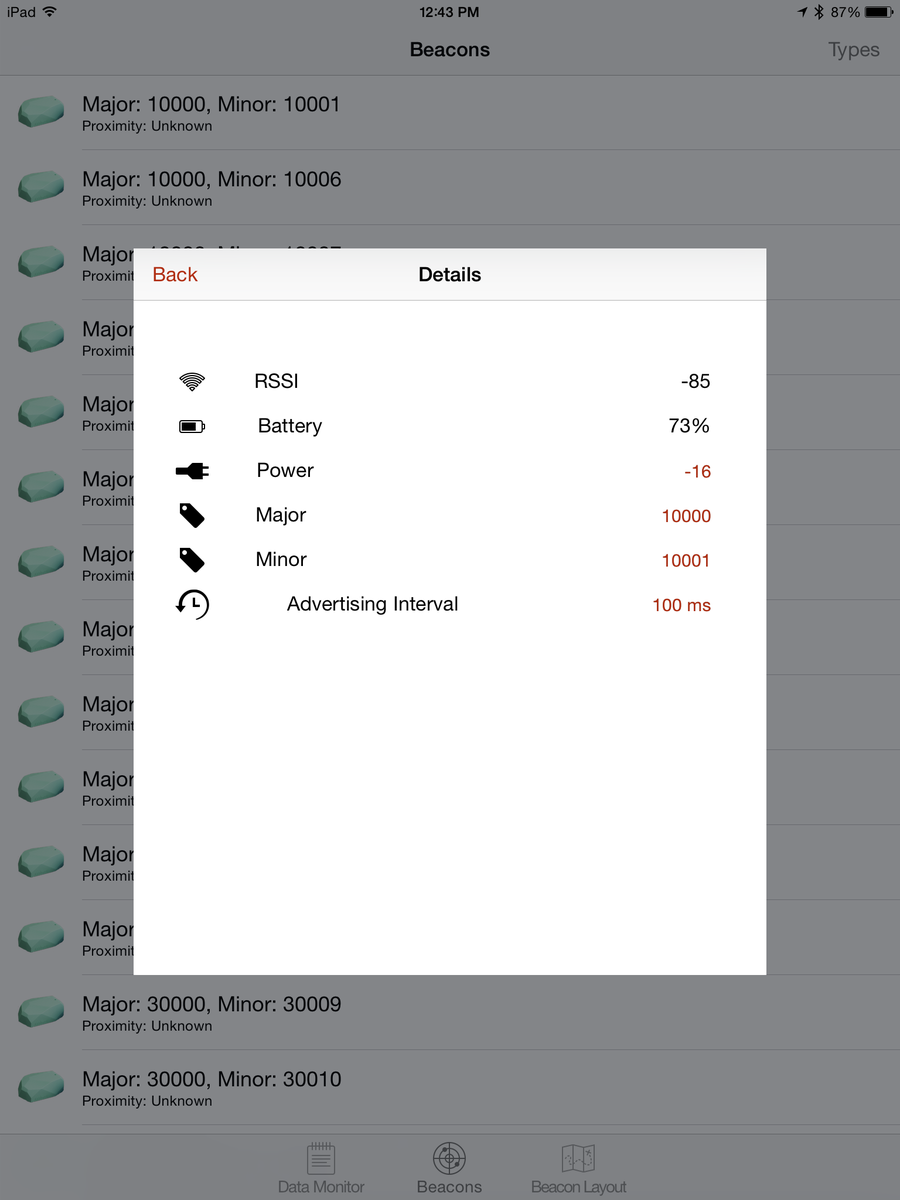
A beacon only announces its number. An iPod in an armband logged each number and its signal strength.
Each beacon's place was marked by hand on a plan in the app.
A position is a weighted mean of places,
and the loudest beacons decide.
Scan
Readings under 125 ms apart: about one scan a second.
Threshold
Readings at or below −90 dB are dropped.
Weight
The signal, mapped to 50…5, to the sixth power.
Mean
The weighted mean of those beacons' places.
No distance is computed, and a position can't fall outside the beacons around it.
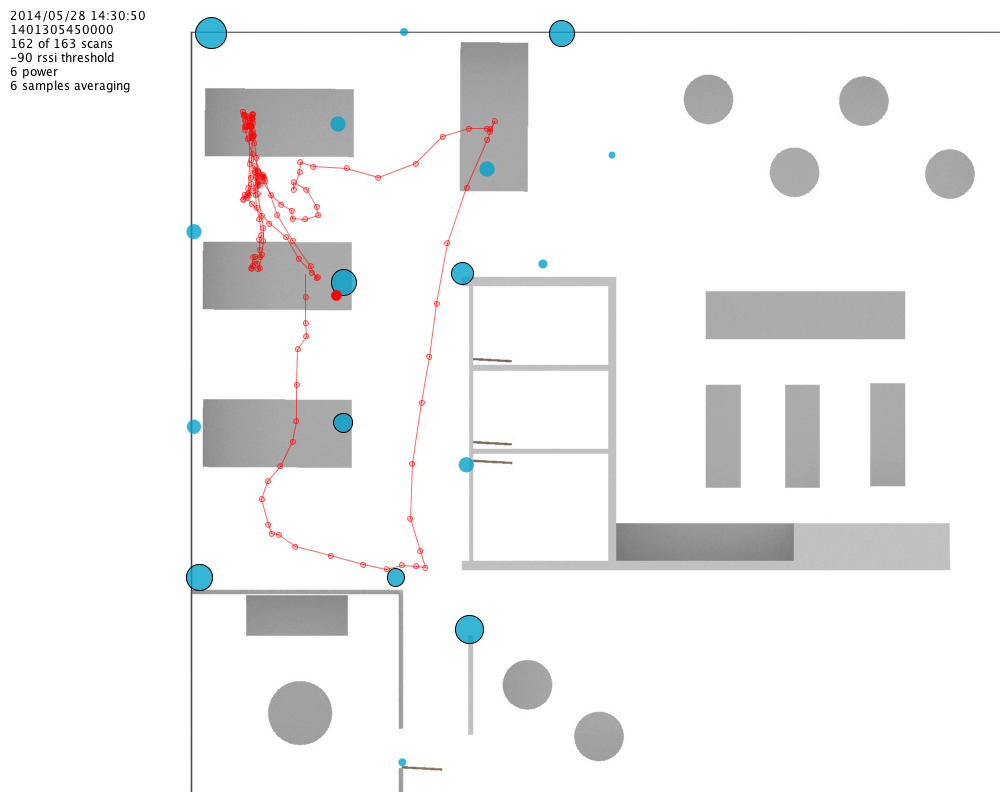
The first walks stayed near the team's desks,
with about twenty beacons.
The viewer drew each scan as a small ring, and each beacon heard as a blue circle, wider when louder.
By July the beacons covered both floors.
Left alone, a position holds to a foot or two.
At known places, it is close near a loud beacon.
1.5 ft
TJ's iPod overnight, twelve hours on one spot: nine scans in ten fall within this of the middle.
3 ft, or 12–20 ft
Seven iPods at listed places, placed by the wall beacons. Four, each hearing a beacon at −65 dB or louder, came within 3 ft. The other three did not.
Wearers volunteered and knew what was logged,
and most of them were the team.
A consent form and the app's own consent screen survive, listing what was logged. At least four of the seven iPods were on the team's own arms on each surviving day.
Every track is shown under a label, with no names: TJ's own as TJ's, the others as numbers and letters.
Four working days of raw logs survive,
and one hour of the second phase.
| 31 July; 7, 8, 11 August 2014 | Raw logs from all iPods, both floors |
| 12 to 15 August | The team's computed positions, lower floor only |
| 28 May to 15 July | Shorter logs from one device at a time |
| 23 October | One hour from all seven fixed iPods |
| Not found | The rest of June to November, the surveys, and any analysis of dwell or of people together |
The approach was viable for seeing where a few people went,
at the scale of an aisle and not of a chair.
What it gave
A walk reads as a walk, and a day as long stays joined by short trips, with no camera and nothing to wire.
What it cost
It knows only those who wear the iPod and keep it running. Batteries died in the first days. Near edges and in the elevator core the position fails or is pulled inward.
The logs show who was near whom.
They do not show collaboration.
On six of the eight days, some pair of iPods spent ten minutes or more within 15 ft of each other and away from their usual places. Whether those people were working together, the logs can't say.
At about a reading a second, two iPods moving side by side for more than a few seconds is rare in these logs.
“Data does not arrive already labeled with the meaning of an activity.”
Everything on these slides traces
to a small set of sources.
- The team's logs: raw beacon, motion and sound files, and computed positions, 2014.
- The team's layouts of the beacons, plans of both floors, viewers and app, 2014.
- The team's project write-ups, deployment tracker and consent form, 2014.
- TJ, Modeling Activity, 2026, pp. 3–4.