Device ecosystems, 2011–12
A study of how people live with their laptops, phones and tablets, for a technology client's hardware group.
The study followed the devices and accessories
people call into action, across their days.
Its anchor is things. People and places come in as the study's other two ways into the same activity, and its model of activity is how attention moves among devices.
“A framework for doing so was anchoring the activity from the perspective of the person, place, or thing.”
The team's hypothesis was that an ecosystem
can be anchored in people, things or places.
“Our overall hypothesis is that there are three ways to approach an understanding of ecosystems, each of them different in what aspect we choose to ‘fix’ while allowing the others to vary. We can anchor the data in rich and dynamic descriptions of People, of Things, or of Places.”
It asked what personal ecosystems are,
how they change, and how to question the data.
- What are the composition, uses, nature and constraints of personal ecosystems?
- How can they be changed, and at what levels?
- What is the most useful way of gathering, representing and interrogating user behavior data?
It was a proof of concept: that instruments
can show how a person's things live together.
“The study is more proof of concept and the viability of the approach. More qualitative than quantitative.”
So this is a picture from 18 people's days, in cases and patterns. It is not a measure of how people in general use their devices.
The instruments put sensors on the things
and a logger on the software.
67 accelerometer loggers
On laptops, phones, tablets, keyboards, mice and bags.
An application logger
On 16 laptops, 9 phones and 5 tablets.
GPS on each person
Coded: home, work or school, other, in transit.
Bluetooth
14 loggers and 6 beacons.
A device logger
On 5 laptops: what was plugged in.
Self-report
Interviews, photographs, a diary, text surveys.
TJ designed and built the logger: on a small
board, an accelerometer, a clock and a card.
“I designed and built the logger. This was loosely based on the PlaceLab and MITes work.”
It logs about eight times a second after a vibration, and about every 10 seconds otherwise.
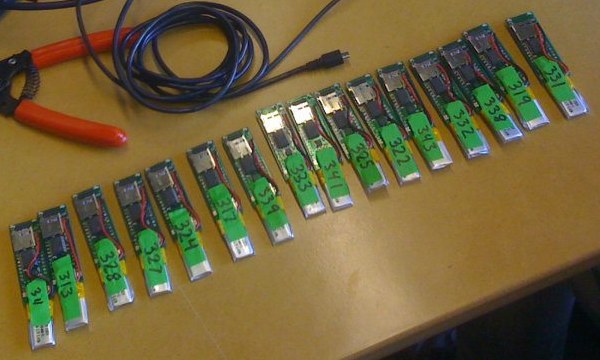
Bags and briefcases carried sensors as well,
to track what moved with them.
“Briefcases, backpacks, bags with RF sensors in order to build a detailed picture of personal ecosystems and its dynamic – PCs, phones, notebooks, mice, etc.”
The team also lists GPS trackers and in-home sensors. The study's database records loggers on two people's bags.
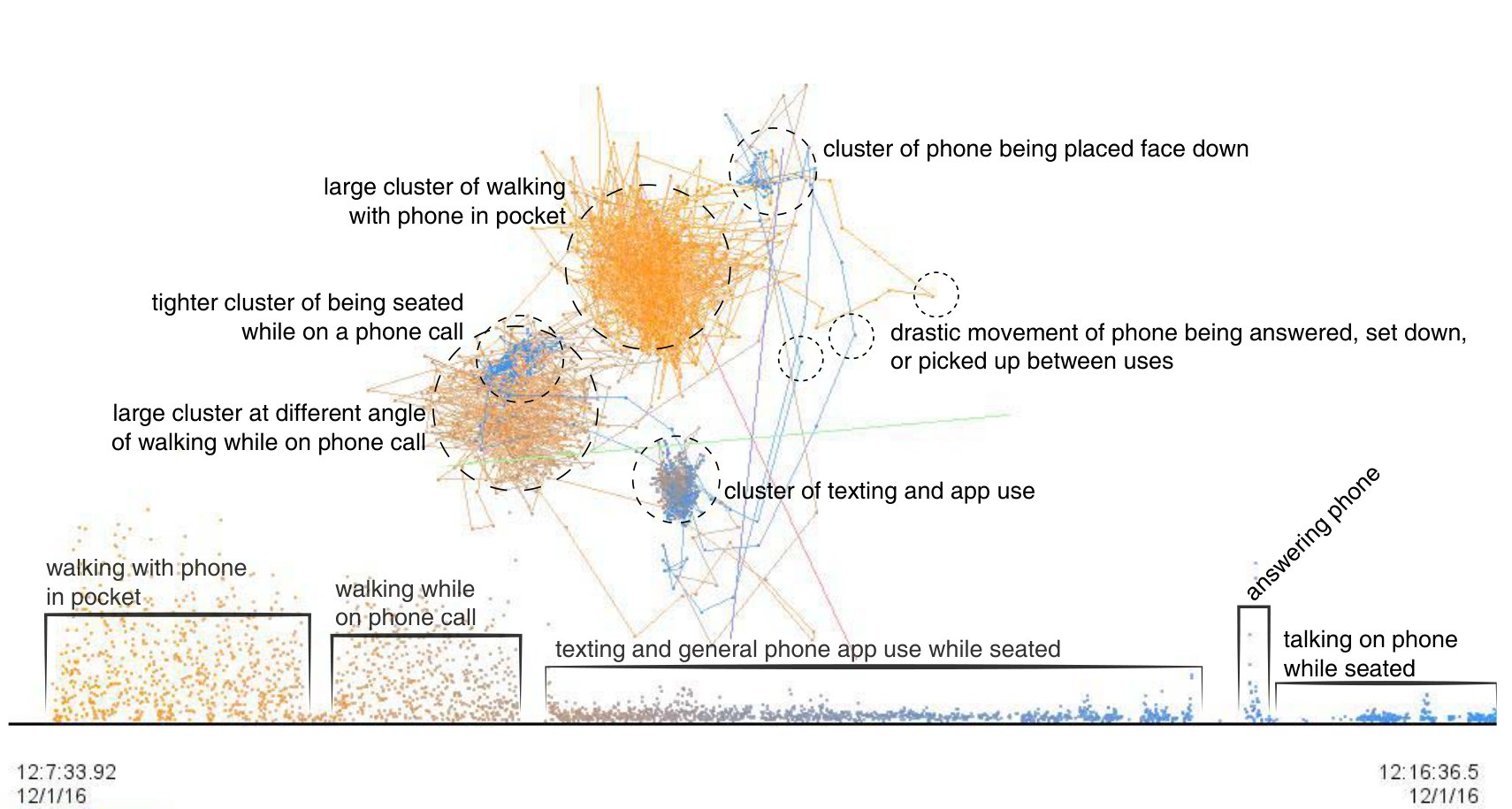
The team recorded known activity on purpose,
to see what it looks like to the accelerometer.
“I'm pretty sure the data sets in the images are from scripted activities in the lab.”
So these are training examples, and not what the study's participants did.
A pilot in 2011 tried the kit on two people,
each with different instruments.
Participant A
Ten days in September
Six accelerometer loggers, on a PC, a phone, a tablet, a table and two chairs, and a GPS receiver for one day.
Participant B
August to September, on and off
Two Bluetooth loggers, one beacon and a GPS receiver.
Its question, in the team's words: “What things are with me? Why?”
The fieldwork recorded 18 people for weeks,
and changed something partway through.
Baseline
Sensor data and self-report across all activities.
Focus
Sensor data and self-report on one activity: create, consume or connect.
Perturb
A new tablet for the four with none; for most others, a keyboard or software.
Eight used tablets and tablet accessories, six used tablets alone, and four had no tablet.
Each person's logs survive, with the database,
and the diary's text was not among the files.
| What | What survives | On the page |
|---|---|---|
| Application logs | 16 people, 110,491 rows, 1,275 hours | Category and seconds, by five-minute bucket |
| Loggers | 67 on 18 people; labeled movement for 15 | Minutes moved; when each logger held data |
| GPS | Tracks; codes for 14 people's study days | The team's codes only |
| Bluetooth | 14 loggers; other people's device names in them | One person's own beacon, and counts |
| Configurations | 330 coded diary records | Which things appear together |
| Diary, surveys, interviews | Not among the files read | Not drawn on |
The model crosses continuity with activity,
and names three ways of managing attention.
| Single activity or multiple related activities | Multiple unrelated activities | |
|---|---|---|
| Continuous: fills the logger's five-minute bucket | Attending | Tacking |
| Not continuous | Darting | |
Devices and accessories are called into action
for a goal, in a context.
Plan
Goals, focus and an anticipated context set a configuration.
Use
Things are staged for use or called into action.
Assess
The outcome is weighed against the expectation.
Change
Configurations become habits, or give way to others.
Run over every bucket, a rule finds the phone
darting and the tablet attending.
| In-use buckets | Attending | Tacking | Darting |
|---|---|---|---|
| Laptop | 34% | 33% | 32% |
| Phone | 17% | 4% | 79% |
| Tablet | 57% | 9% | 34% |
The rule is added here: continuous at 295 s, one activity at 80%. Its commonest mode matches the team's own label on 11 of 15 windows. These shares describe these people's logs, not a population.
The approach held together: separate streams
can be read as one person's day.
One picture of a day
Loggers on things, logs on software, the team's place codes and beacons can all be drawn as lanes in a single day.
Things with a person
In the pilot, on the one day with GPS, the phone, the PC and the tablet moved when the person did, and the furniture did not.
A way to talk about attention
The team could read those lanes as attending, tacking and darting, and a simple rule reads most of its windows the same way.
The team came away with provocations,
questions for design more than measures.
- “Device-driven time expansion.”
- “Multitasking. Conventional wisdom says that people do one thing at a time.”
- “Time ‘darting’.”
- “There is a lot to do in bed: the new horizon for computing.”
- “Hardware is invaluable, yet, people don't really care about hardware.”
The model rests on 18 people, a five-minute
bucket, and logs that see only some devices.
- Eighteen recruited people, over two to three weeks: a model from observation, not a measure of a population.
- Nothing shorter than the logger's five minutes can be read as continuous.
- iPads and iPhones have no application logs, and two people have none at all.
- Movement says a thing moved, not that it was used.
Its models are partial, as all models are,
and the observations can revise them.
“They are necessarily partial, reflecting the limits of perception, instrumentation, available knowledge, and the assumptions embedded in their construction.”
“An observation is not an activity model.”
It rests on the team's own files and words,
with the client's name left out.
- Each participant's application logs and the loggers' files; the study's database, March 2012.
- The team's map of connections, its labeler and its training sets.
- The team's words and terms are from its own documents of 2011 and 2012, which are not public.
- McLeish, Computational Design; McLeish, Modeling Activity; TJ's answers, 2026.