Candy bag, 2011
A study of how a bag of candy gets eaten, for a confections client. A proof of concept.
The study followed a bag of candy through
people's own days, with a sensor on the bag.
Its anchor is a thing, with people and places beside it. Its model of activity is how a bag is eaten.
“Instrumented candy bags, supplemented by location information, participant video, and interviews, offered a view of consumption across times and situations.”
The question here is whether it worked,
and what kind of picture it gives.
- Could a sensor on a bag follow eating through ordinary days?
- Do its readings line up with what people showed on video?
- How far does it reach on three things: one sitting or not, at home or not, poured or picked?
Each person's kit held a sensor pack,
a GPS receiver and a pocket camera.
Sensor pack
Stuck to a bag where the person usually held it.
GPS receiver
Carried everywhere: a fix every five seconds when it had one.
Pocket camera
For video stories, talking aloud while eating.
Two bags
To start with, of the sizes the team assigned. An online study ran alongside, moderated by Ann Kauth.
The sensor pack read touch on six copper plates
and movement on three axes.
It wrote a row on any change: about eight a second while moving, and one every 10 seconds otherwise.
TJ designed and built the logger, and wrote its firmware.
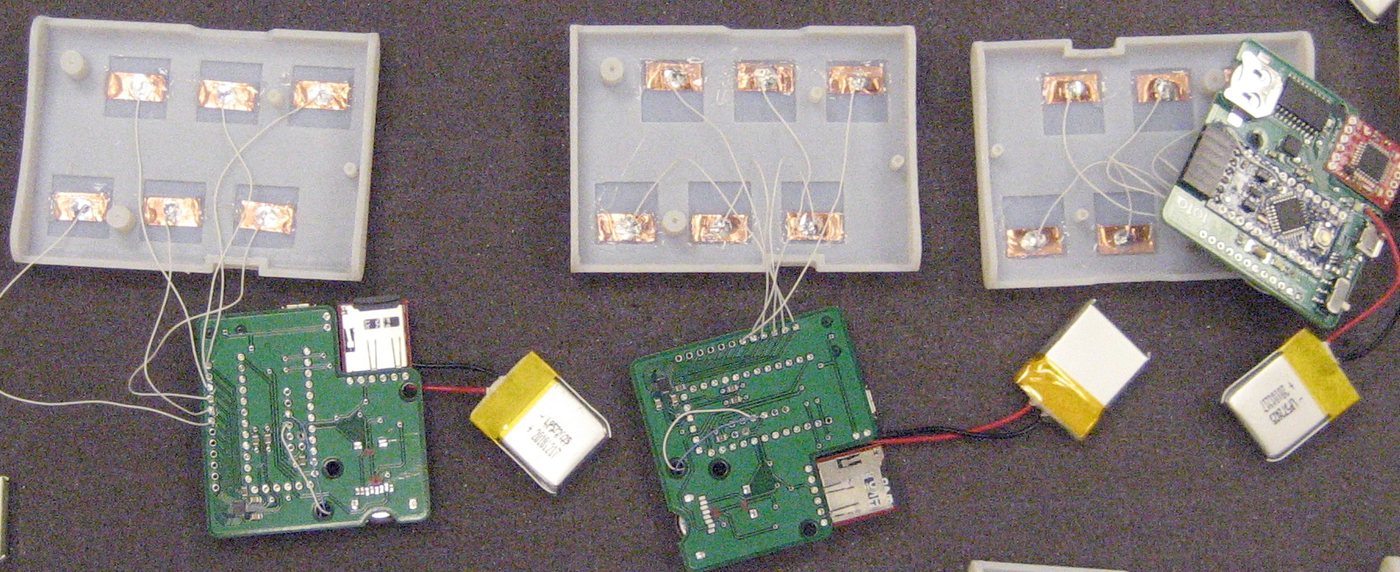
There was one pack to a person, bag to bag,
so a bag's life depends on the team's labels.
- Each person stuck the pack on with adhesive dots, moved it to the next bag, and charged it at night.
- The readings do not know which bag they come from, or how much candy is left.
- The team's table labels 63 stories from 16 people, which this draft reads as 40 bags.
The pack's rows and GPS tracks survive,
with the videos and the team's labels on them.
18 of 20
kits left usable logs: 5.6 million rows, about 3,000 hours.
18
GPS tracks, shown here only as codes: at home, elsewhere, in transit.
63
stories with the team's labels, from 16 people.
6
homes' interview pictures and video. They stay local, with the participants' videos.
The stories show in the readings,
though the pack was not always on the bag.
| Within 15 minutes of a story | Stories | Same clock time, other days |
|---|---|---|
| A move | 37 of 59 | 23% |
| A touch | 29 of 59 | 10% |
| No movement at all | 22 of 59 |
So the clocks line up, and stories have a signature. Of those 22 stories, the logger was off for 7.
A session is handling, which includes eating
and is not the same thing.
A session is a rule added here: moves and touches with gaps of five minutes or less, holding at least three touches and a move.
| Days people said they ate | 21 of 34 had a session |
|---|---|
| Days people said they did not | 8 of 20 had a session |
The model asks three things of a bag,
and the readings reach two of them in part.
| How a bag is eaten | What answers it | Reach |
|---|---|---|
| In one sitting or not | The team's label. The pack shows how handling spreads, not how much is left. | In part |
| At home or not | The team's label. GPS codes agree on 26 of the 34 stories that have one. | In part |
| Poured or picked | The team's label, from the video. | No |
The readings do not tell pouring from picking;
that label rests on the video.
Only 26 stories have readings near them and a clear label: 21 poured and 5 reached, from 11 people, none of whom has both. So a difference in labels can't be told from a difference in people.
| Measure, where 0.5 is a coin toss and 1 complete | Separates the labels |
|---|---|
| How far the pack tilts | 0.39 to 0.50 |
| Seconds moved near the story | 0.91 |
The model stops where the data stops,
which is part of what the study shows.
“An observation is not an activity model.”
“In each case, the act of instrumentation revealed the limits of what was directly observable, while modeling provided a way to consider what those observations might mean.”
These are a few people and bags,
so the numbers do not measure a population.
- Sixteen people with labeled stories, over about ten days.
- The labels describe videos people chose to make.
- Plates could stick on for hours, and 22 of 59 stories have no movement near them.
- GPS has no code for 25 of 59 stories, and home is inferred.
The sources are the team's own files and tools,
with the client's name left out.
- The sensor pack's firmware, May 2011; the team's data viewer and its library, 2011, from which the move rule is ported. The port returns the team's own motion counts for all 16 people it ran.
- The loggers' files and GPS tracks; the team's table of story labels, July 2011; the online study's check-ins, yes or no only; the kit script and field kit; the in-home discussion guide.
- McLeish, Modeling Activity; TJ's answers, 2026.