Bottle cams, 2012
A camera with sound and an accelerometer on spray bottles of household cleaner, in three homes, recording when the bottles moved.
The study followed cleaning products through
people's homes, from the bottle's own side.
Its anchor is things. Places and people come in as the other two ways into the same activity, and its model of activity is the product's journey: out of storage, used, kept out or put back.
“A framework for doing so was anchoring the activity from the perspective of the person, place, or thing.”
As a proof of concept, it asks whether an object
can report its own use, closely enough to draw.
The client suspected its product was “stuck” in homes and in people's minds. The team's answer was to go and look, from the product.
“‘Bottle Cams’ adorning cleaning products recorded sound, video, and accelerometer data when the bottles moved. We pieced together data streams to recreate the product's journey.”
A bottle cam is a camera, a microphone and
an accelerometer, in a housing on its neck.
The accelerometer reads three axes eight times a second. The logger writes a row whenever an axis changes by two counts, and one about every 10 seconds otherwise.
The camera took 640 × 480 video, with sound at 24 kHz.
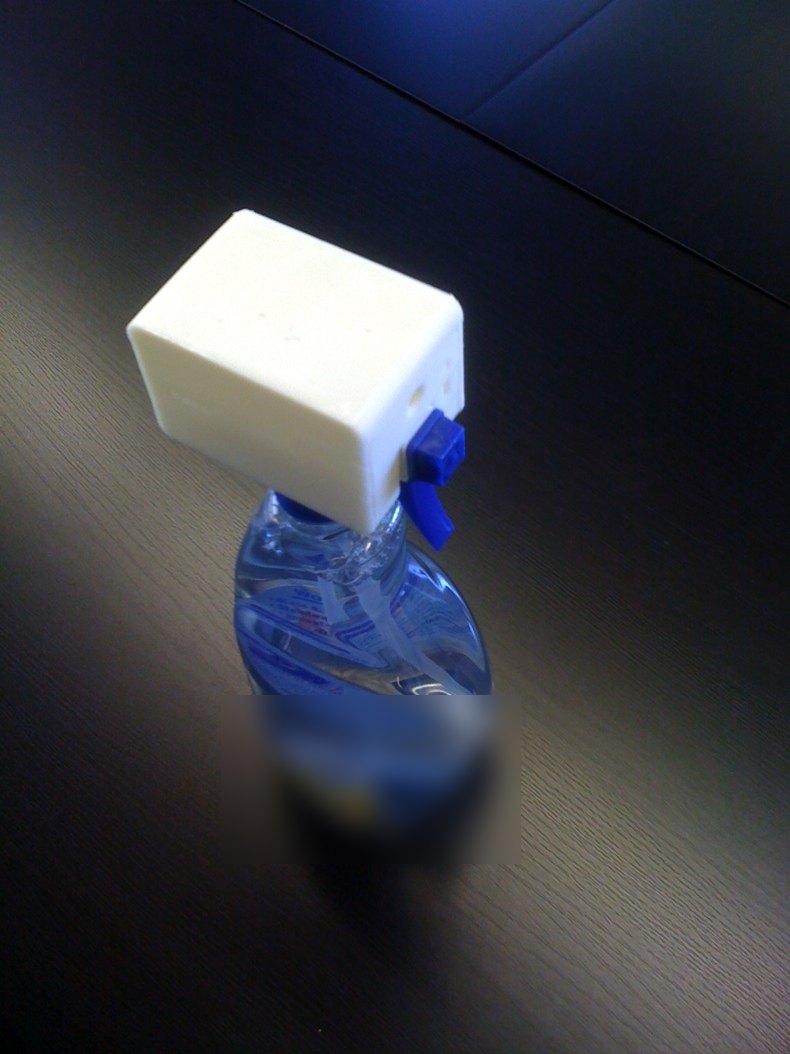
The bottle decides when to record: two seconds
of change wake it, 45 of stillness send it back.
It moves
The log has this from the first row.
About 3.5 s
The camera switches on.
About 8 s more
The camera records.
About 45 s still
The camera sleeps.
So the first dozen seconds of any movement, the moment a bottle leaves storage, are in the log and not on the video. Piecing the streams together had to mend that.
Four streams had to be pieced together,
and each mends a gap in the others.
| Stream | What it gives | What it can't |
|---|---|---|
| Motion log | When the bottle moved, all day and all night | What for |
| Camera and microphone | What the bottle saw and heard | The start; most wake-ups show no use |
| The team's labels | Room, object, surface, tool, squirts, mode | Anything but one team's reading |
| Scales | How much left each bottle | When |
Nearly all of it survives: the logs, the clips, the
labels, the firmware, the viewer and the model.
428
wake-ups in the study, on four bottles in three homes
397
of them left a video file
68
held a use, by the team's reading
152
labels: one for each thing cleaned
The clips show people and their homes, so their pictures and sound stay on the study's computer until they have been reviewed. Everything on these slides is drawn from them.
Between clips the bottle is drawn where it was
last seen, and that line is reconstruction.
Solid lines come from what a clip shows. Dashed lines rest on two things: the place the team saw the bottle at the end of one clip and the start of the next, and a motion log that says it hardly moved between them.
In a few places the two disagree, and the bottle turns up somewhere new. The chart shows those as a dashed jump.
Kept out or put back was a habit of each home,
and not one number across them.
| Bottle | Clips with a use | Back by the clip's end | Back within the hour | Where it rested out |
|---|---|---|---|---|
| 300, home H1 | 16 | 2 | 4 | Kitchen counter and dining table, for days |
| 315, home H2 | 13 | 10 | 10 | Rarely out, but for a day in a car |
| 337, home H2 | 19 | 16 | 19 | Hardly ever |
| 348, home H3 | 20 | 10 | 13 | Counter, hallway, dresser; stored on a window sill |
A bottle leans further for a table than for a mirror,
and the log alone can show it.
Over the labels the team coded, the bottle's median lean is about 38° on horizontal surfaces and about 18° on vertical ones. All four bottles show it, in all three homes.
“Instrumented cleaning products offered evidence about patterns of handling and use.”
The team's model is a cycle: out of storage,
decide, use, judge, then kept out or put back.
Storage
Which is not always storage.
Decision
To clean, and with what.
Use
Spot, habitual or planned.
Evaluation
Did it work?
Out or stored
And round again.
“Data does not arrive already labeled with the meaning of an activity.”
Modes were the team's reading of each clip,
as far as anyone could see why.
| Mode | As the team defined it | Timeframe |
|---|---|---|
| Spot | Directed, limited cleaning; not necessarily planned | Short, and may expand |
| Habitual | Cleaning seen as part of other activities of everyday life | Short to medium |
| Planned | Routinized, intentional cleaning | Medium to long |
The sensors don't say this. The labels do, by people watching the video and listening to what the person said to the camera.
The bottle cams were the closest look inside
a larger study of fifteen homes.
- Twenty more bottles carried only an accelerometer.
- Four homes had an instrumented caddy, with cups for four products.
- Eleven homes had a handheld camera, with which people recorded some of their own cleaning.
A later round, in 2013, planned a pump bottle and separate cameras triggered by it. Hardware and a page of notes survive, and no data was found.
The approach gave a close picture of a few
bottles, at a cost that grows with each one.
What it gave
A bottle's days, room by room. How a use looks, moment by moment. Where each bottle rested. A check that holds: lost weight against squirts on video comes to 0.62 to 0.71 g a squirt.
What it cost
Most wake-ups held no use: 3.7 of 11 hours of video. About one in fourteen left no file. Every use was watched and coded by hand, and every card fetched from a home.
Four bottles in three homes describe those
homes, and do not measure how people clean.
- People knew the camera was there, and many talked to it.
- The labels are one team's reading of the video, made by hand.
- A clip's end isn't the end of a use: some bottles “kept out” went back minutes later.
- “Storage” is itself a reading: the team changed its mind about one window sill.
TJ's account of this work keeps the observation
apart from the model built on it.
“Models remain selective. A sensor has a range and resolution; an event model establishes boundaries; a spatial representation omits aspects of experience.”
“An observation is not an activity model.”
The page and these slides rest on the team's
own files, kept where they were found.
- The four bottles' motion logs and the study's camera tables and labels, June 2012 to January 2013.
- Its firmware, video tagger and viewer; its 3D model of a journey, July 2012.
- TJ McLeish, Modeling Activity and Computational Design, position papers, 2026.